SEA ICE ADVENTURESeptember 24th - 29th With 11 Huskies, two companions and a heavily loaded Nansen sled Food: All dried: meat, fruit concentrate, cereal, sledging biscuits, pemmican. powdered milk, powdered egg, tea, coffee, canned butter, dried vegetables, bread Dog food: Pemmican blocks. During the year, the possibility of making a dog trip was talked about, and as it became known that I had had some snow camping experience, I was asked if I would like to accompany Peter and Ron on a journey south of the station to see the Vanderford Glacier, a massive ice tongue at the southern end of the Windmill Island group. It was a great opportunity to experience the historic mode of travel that had once been so popular. 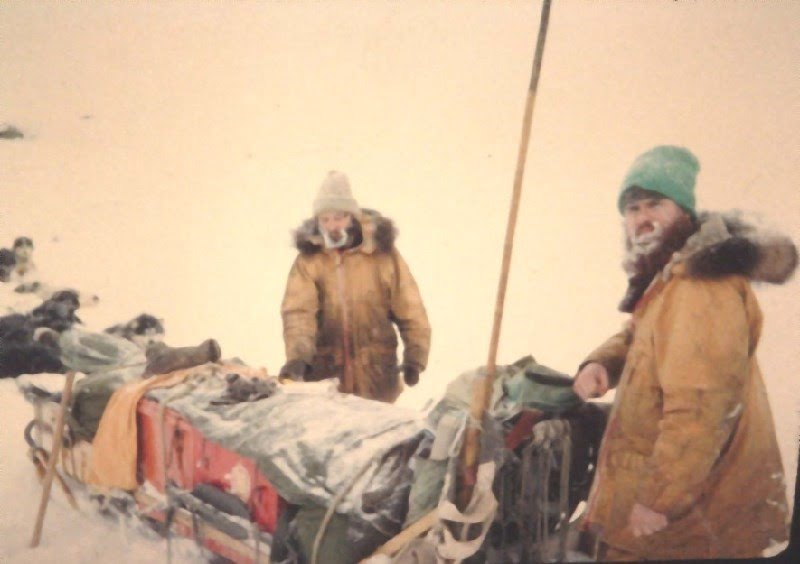 TUESDAY SEPTEMBER 24th:We left Wilkes Station at 9 am after an early breakfast, last - minute packing and harnessing the dogs. The latter was an exhausting business. The dogs were so eager to go.... it took all one’s strength to hold each one while the harness was fitted and they were clipped onto the trace. They usually helped with the harnessing, a leg was always lifted at the right moment. With the huskies showing extreme excitement, it was not uncommon to have giant front paws planted on my shoulders and a sloppy tongue slapped all over my face. They all showed great affection toward us. Our lead dog, Finster was superb and smart; an intelligent and experienced animal that knew voice commands well. He realised that his job was just to steer the team. 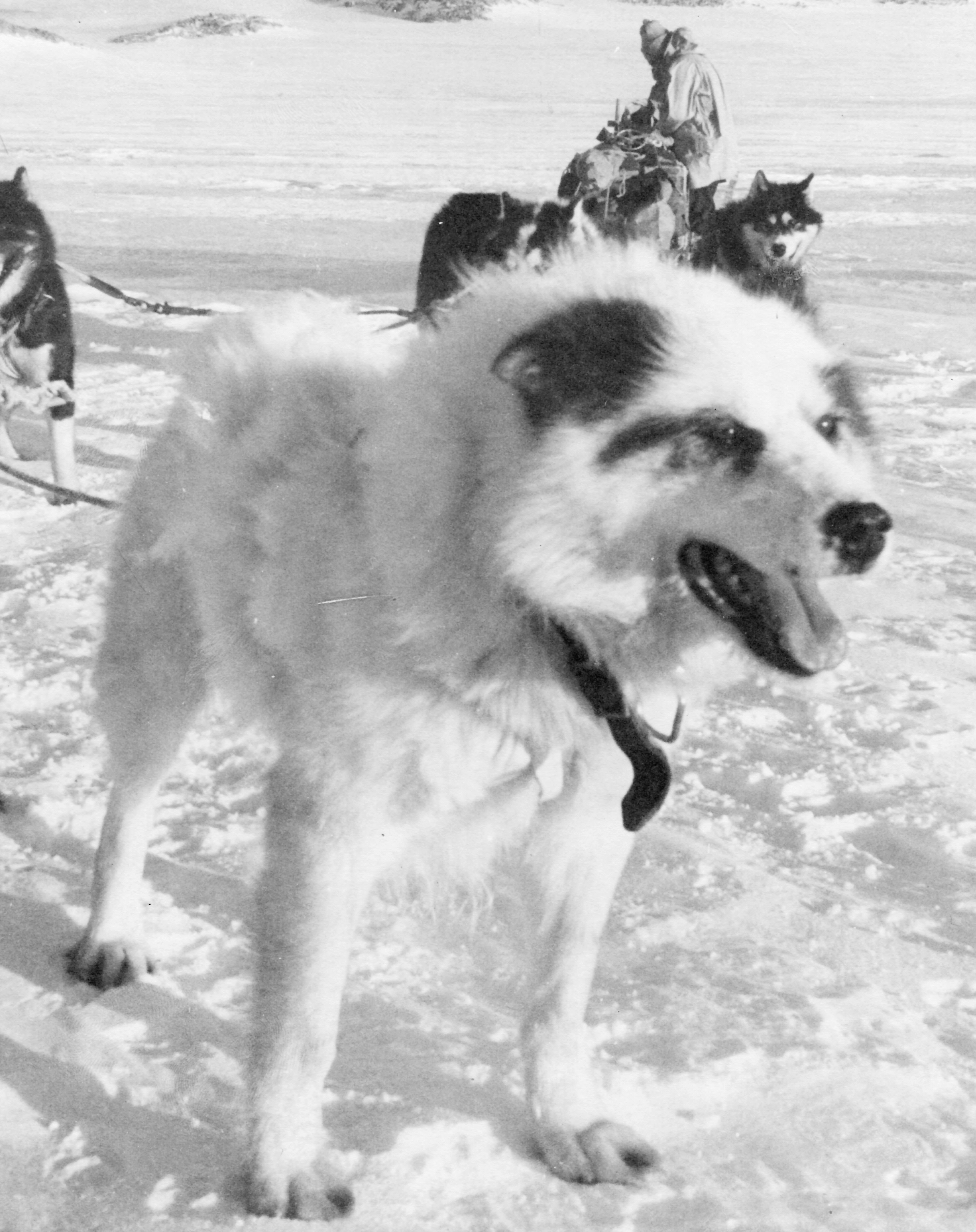 It is customary when praising the dogs to go around them all with a big hug. Rivalry can cause problems and one has to be continually on guard should a fight break out. The dogs turn into snarling killers (toward one another) in an instant and it must be broken up by a boot, or any implement that can be grabbed quickly. Toward their handlers though their only desire was to jump up, give us great hugs and lick our faces. Finster was a very special dog and I think the team knew that As the Doctor and Rod saw us off, the dogs leapt away, down the hill and onto the sea-ice. They took off withsuch speed, that Peter jumped off the sled and chose to run the first part of the way with me. Ron held on desperately as the sled lurched over the broken ice and snow of the shoreline tide cracks and pulled the dogs up in the bay so we could catch up. Weather conditions were poor. Snow was falling heavily, limiting our visibility. The dogs soon settled down and running with the characteristic tail curled forward we made good time across Newcombe Bay, past Repstat and Shirley Island. We rounded the ice cliffs of Shirley Island and saw O’Brien Bay on our left. Brian and I had walked along the cliff tops here one evening last summer. We travelled for almost an hour before we entered Roberston Channel and soon we could see Ardery Island. We were walking and jogging in 3 to 6 inches of soft snow which made it difficult going for the dogs as the sled was not sliding well, frequently becoming bogged down in drifts. I had to shed clothing, as I worked up a sweat, even though the temperature was well below freezing. Soon we reached the headland and Sparkes Bay, where we had originally decided to make our first camp but found we had plenty of time to push on further. In poor visibility, we crossed Sparkes Bay and halted briefly at Odbert Island where we rested the dogs. Then we were away again to Ford Island, where the snow fall thickened and we stopped to discuss our situation. We had been able to see the Browning Peninsular for some time, but it was lost now in the whiteness of the snow. We decided to investigate the possibilities of camping on the island if visibility did not improve, but as we tried to climb up onto the land looking for a campsite we fell through a snow covered slot near the water’s edge. However, the snow-fall had eased considerably, so we continued southward. Ron and I saw a seal lying near some broken ice and, walking over, found no less than four Weddell seals. We took some photographs then returned to the sled. Peter was by now half a mile away, heading toward Browning Peninsular. Late in the afternoon, arriving at Peterson Island, near Browning Peninsular, we ran the dogs up onto the shore ice and camped. The dogs were un-harnessed and clipped onto the line, which we staked out on the ice. Then the Polar Pyramid tent was erected and a meal was prepared. The temperature had averaged about +6F (-14C) all day. During the night, the wind increased from a gentle breeze to gale force which lasted for some hours. We were all rather tense, as the tent was pitched, on ice, on the shore-line, the only reasonably level area available. first run of the day is not a good time for riding the sled! 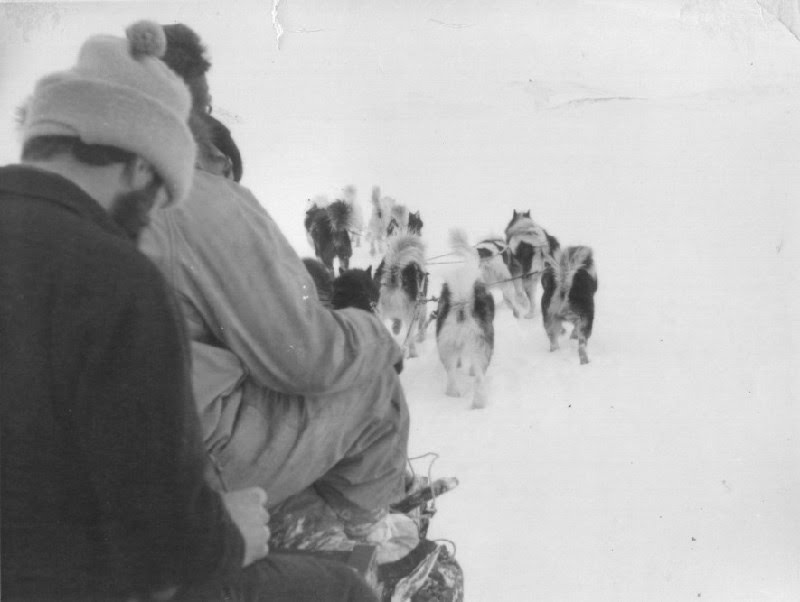 WEDNESDAY
SEPTEMBER 25th: (Elizabeth’s birthday) Fortunately, by morning, the wind
had dropped. After breakfast, we set out from camp to gain a better view of
Vanderford Glacier. Walking in full polar dress was very tiring, yet 15 minutes
later, we had reached the point of a small headland.
. We climbed to the summit of this, took some photographs of the glacier (still partly hidden) then headed down and across some broken sea-ice and up a higher peak from which we had an unobstructed view. We
returned via the northern end of the point on the sea-ice. We noticed a small
penguin rookery high up on one of the hills, where the rock formation was
mainly granite. On Wednesday night a blizzard set in. The wind blew at gale force throughout the night carrying with it blinding drift. The tent though was warm and draught free with plenty of room for cooking and sleeping. Sleep was disturbed, because the sounds of the sea-ice grinding against the shore were conducted through the ice on which we were lying. Squeals, groans and clunking noises sounded through our pillows THURSDAY SEPTEMBER 26th :Throughout Thursday the blizzard continued. I fed the dogs during the afternoon and found them curled up, nose to tail and covered with ice. Several were actually frozen into the hole they had been lying in, so I chipped their coats free with the ice axe. We were hoping the wind would remove the light powder snow from the sea -ice without removing the ice itself. With the hand cranked transceiver, I received two telegrams from home, including one from Elizabeth, forwarded by the radio operator at Wilkes Station on our daily sked at 5 pm. The strong wind continued so we prepared for another anxious night. The dogs howled in wolf-like manner, all through the night, because of the wild conditions. What a din they made! FRIDAY 27th SEPTEMBER:On Friday morning, in heavily overcast conditions, we headed the team north from Browning Peninsular across the sea-ice to Odbert Island, where we were forced to stop because of a rising wind and drift. Calm weather through the night brought a heavy snowfall which left about 6 inches of powder snow on the surface. On this section at one stage, we were over 4 miles (7 Km) off shore. We could barely see Ardery Island when we moved off this morning, but we were very anxious to leave, even though there was a moderate breeze, carrying with it large snow flakes. The dogs pulled well and we made good time over rough patches of sea-ice. A characteristic of the Nansen sled is its ability to bend and twist. Built with strong flexible timber, with all the joints lashed together with leather thongs, it handles rough ice very well. The foot brake was only used when harnessing up. This trip was very strenuous, with some cause for anxiety should the sea become rough out beyond the frozen limit. This could break up the sea-ice, which, with the prevailing wind from the plateau, could push it out to sea, leaving us marooned on an island (or on a floating ice floe). EVEN THOUGH WE WERE IN CONTACT WITH THE BASE, THERE COULD BE NO HELP FROM THAT SOURCE, AS THERE WAS NO BOAT AVAILABLE. Our intention had been to camp near Sparkes Bay. However, there was no easy route to get the dogs and sled ashore. There were sheer ice cliffs for much of the coast line. So a comfortable camp was set up on Odbert Island, the dogs were fed and we had a well earned rest. Weather permitting, we planned to visit Ardery Island the next day. Our Fairy Down ‘Everest’ sleeping bags on insulating board slabs kept us very warm.SATURDAY 28th SEPTEMBER We were out of bed and walking the mile across to Ardery Island from our camp on Odbert Island by mid-morning. The sea-ice was firm although the soft snow was tiring. Soon we approached a sheer rock wall, into which many birds were flying in and out of nesting areas. Getting ashore was tricky because of soft fresh sea-ice along the tide cracks, but we skipped over the mushy areas and began the climb to the summit. 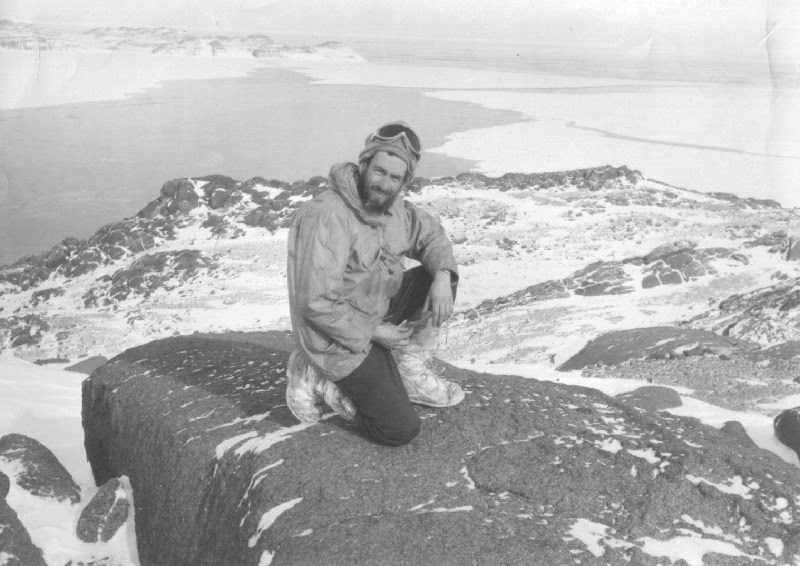 The tide-crack was re-crossed on a spongy mush of ‘plastic’ sea-water and we reached camp half an hour later. Then, after a quick snack of stew and Antarctic (sledging) biscuits we broke camp, harnessed the dogs and left for Repstat, 6 miles away. It started snowing during the afternoon and we negotiated the Robertson Channel and O’Brien Bay in very poor visibility. The dogs knew the way and did not require guiding at any stage. The snow was deep in places with several high drifts near Pidgeon Island, where the sled tipped over once. Despite this, we made quite good time, arriving at Repstat in a heavy snowfall at about 4.30 pm. Even though visibility at this stage was only about 50 yards, Brian saw us arrive and ran down to meet us. Altogether we had covered a distance of 27 miles (43 km) of sledging, including 14 miles (29 km) on the first day. In addition, there had been the various walks we had done. Although the whole trip had been made in gloomy overcast weather, it had been a great thrill for the three of us to be in such a cold, remote, lonely place on the Antarctic Circle, where few people have ever been - totally dependent on our own skills in the threatening conditions, and the ever willing spirit of our friends the Huskies.
|
Home > Years >
1967 | 1957 | 1958 | 1959 | 1960 | 1961 | 1962 | 1963 | 1964 | 1965 | 1966 | 1967 | 1968 | 1969
1967 | 1957 | 1958 | 1959 | 1960 | 1961 | 1962 | 1963 | 1964 | 1965 | 1966 | 1967 | 1968 | 1969